
• Go to the main menu
  • Go to the main content
  • Go to the search form
  • Go to the sitemap and contact
Logo serwisu Regionwielkopolska.pl Logo serwisu Regionwielkopolska.pl
  • Knowledge base
    • History
    • Nature
    • Folk culture
    • Architecture
    • Famous Citizens
    • Tourism
    • Best of Greater Poland
    • Curiosities
  • Catalogue of Attractions
    • Historical Sites
    • Museums
    • Wooden Buildings
    • Religious Buildings
    • Landscape Parks
    • National Parks
    • Monuments
    • Nature Mounuments
    • Nature reserves
    • Castles, Palaces, Manor Houses
    • Other attractions
  • Practical information
  • Contact
  • Quests
Your clipboard (0)

Regionwielkopolska.pl - all about Greater Poland (Wielkopolska)

Patron serwisu: Wojewódzka Biblioteka Publiczna i Centrum Animacji Kultury w Poznaniu Patron serwisu: Wojewódzka Biblioteka Publiczna i Centrum Animacji Kultury w Poznaniu
Your clipboard (0)
A- A A+
A
  • Knowledge base
    • History
    • Nature
    • Folk culture
    • Architecture
    • Famous Citizens
    • Tourism
    • Best of Greater Poland
    • Curiosities
  • Catalogue of Attractions
    • Historical Sites
    • Museums
    • Wooden Buildings
    • Religious Buildings
    • Landscape Parks
    • National Parks
    • Monuments
    • Nature Mounuments
    • Nature reserves
    • Castles, Palaces, Manor Houses
    • Other attractions
  • Practical information
  • Contact
  • Quests
Homepage | Greater Poland (Wielkopolska) History | Major Historical Events | Poznań Bazaar

Poznań Bazaar

  • Greater Poland (Wielkopolska) Uprising 1918-1919
  • Major Historical Events
  • History timeline
  • History of cities

Poznań Bazaar

category:

Greater Poland (Wielkopolska) History

comments: 0
  • add to clipboard
  • remove from clipboard

Those pushing for organic work were determined to win an uprising involving the internal consolidation of Polish communities when conditions were ripe. One way to bring this about was to create a network of banks that would cater for people, unions, economic and cultural societies, agricultural circles etc.

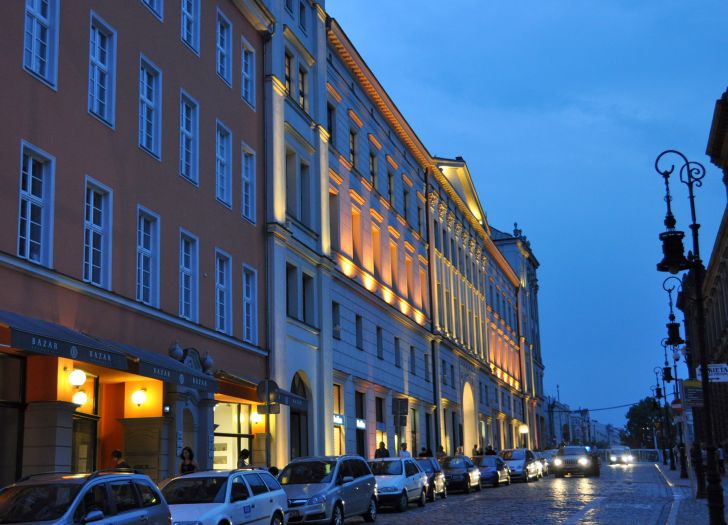
These activities were given a boost around 1838 with the return of Dr. Karol Marcinkowski, a distinguished doctor and social activist. Marcinkowski founded the Spółka Bazarowa (Bazaar Company) that year with the aim of building the Bazar (Bazaar) building in Poznań where a special, informal socio-economic circle could exchange knowledge and experience and spread national traditions. This goal was realised in 1841. Bazar was meant to be the focal point of Polish social and economic life in the region, as well as a place to meet, and a hotel where guests could stay. The ground floor housed Polish merchants’ shops, among them an ironmongery run by Hipolit Cegielski, whose future factories were to become famous.

Over time, Bazar became the major Polish centre in the Prussian partition, a symbolic place bursting with tradition. Leading Polish activists and cultural people stayed here and Ignacy Jan Paderewski was living here on the eve of the Wielkopolska Uprising in December 1918.

 

Gallery

  • Budynek Bazaru w Poznaniu

Comments (0)

Add comment

For our information only
( will not be never published )

Patrons

  • Koleje Wielkopolskie
Knowledge base
  • History
  • Nature
  • Folk culture
  • Architecture
  • Famous Citizens
  • Tourism
  • Best of ...
  • Curiosities
Catalogue of attractions
  • Historical Sites
  • Museums
  • Wooden Buildings
  • Religious Buildings
  • Landscape Parks
  • National Parks
  • Monuments
  • Nature Mounuments
  • Nature reserves
  • Castles, Palaces, Manor Houses
  • Other attractions
Events
  • Practical information
  • Wielkopolska in Web
About us
  • Contact
  • About Sightseeing Workshop
  • We use cookies

Website patrons:

  • Wojewódzka Biblioteka Publiczna i Centrum Animacji Kultury w Poznaniu
  • Samorząd Województwa Wielkopolskiego
© Copyrights by Wojewódzka Biblioteka Publiczna i Centrum Animacji Kultury w Poznaniu
  • Privacy policy
  • Web accessibility